Category: Refit

  • Serena Refit 2020

    Serena Refit 2020

    Since the sailing season in New England was becalmed by the COVID pandemic, Serena made a run down to West Palm Beach. Once there, she started her planned 10-year survey and electrical refit a couple months early.

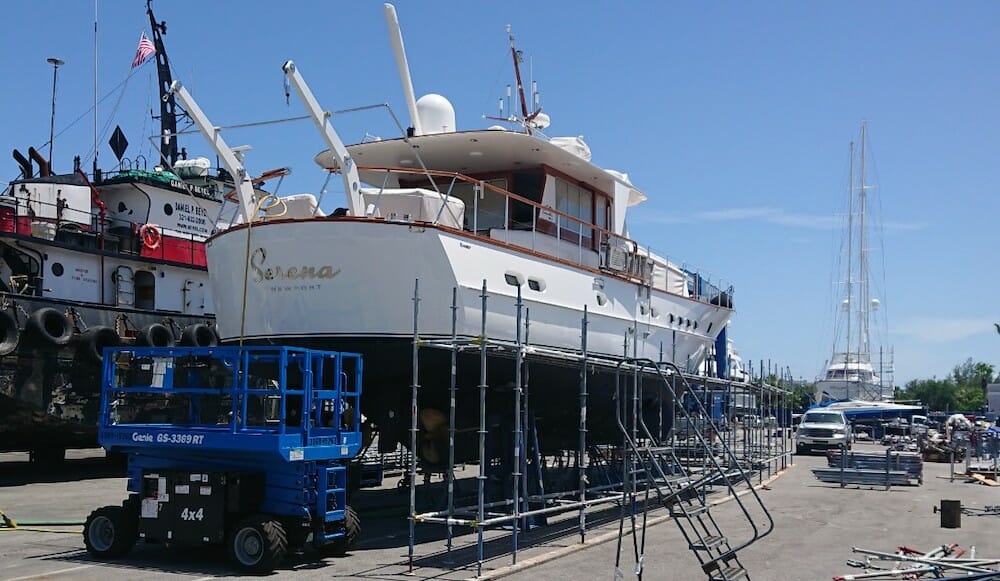
    M/Y-Serena-Rybovich-Yard-Florida
    Serena hauls out at the Rybovich yard.

    Our yacht’s arrival in Florida looked poorly timed when Tropical Storm Isaias began its trajectory up from the Caribbean. Fortunately Isaias’ strongest winds stayed offshore, and all that was lost were a couple days’ time as the Rybovich yard prepared for the worst.

    A sea trial and vibration study had been completed on arrival, and soon after the storm passed, the scaffolding and tenting of Serena was promptly completed. This allowed for maintenance projects to begin, such as exterior varnish work, while the major projects began in the interior.

    Electrical Upgrade

    Project manager Sean Hodgeson described to us the significant electrical work he is overseeing:

    For shipside power, Serena has been running two generators, 16kw and 10kw, which will be replaced with a pair of new 16kw units. Also enhancing the system will be a “load shedding and load sharing” switchboard that senses load and can automatically bring the second generator online when the load requires. 

    For shoreside power, a new frequency converter will replace the currently undersized unit. This will help with load management when dockside (e.g. when cooking, running laundry, air-conditioning, etc.). Because she was built and run for many years in Europe, Serena is wired for 50hz (European) and has a few 60hz outlets for US use. Therefore, her system must utilize a frequency converter to shift power to 50 cycle when plugged into Stateside. It also works the other way around when Serena is in Europe. It can also act as a filter in more remote areas where the power isn’t “clean” and needs to be regularized. 

    Also of significance is the fact that the converter is mounted in the lazarette. The old unit was air-colled and needed an air-conditioning unit alongside it to keep the lazarette from over-heating. The new unit is water-cooled, which will allow for the removal of the AC!

    Fully tented and with teak decks covered, maintenance projects can begin.

    10-Year Survey and Other Upgrades

    Sean pointed out several other significant tasks that will be underway over the next couple months, many as part of a 10-year Lloyd’s inspection survey.

    Lloyd’s survey tasks: The yard will pull, inspect and replace as needed all propellers, shafts, stabilizer fins, and any valves and thru-hulls. Audio (ultrasound) gauge readings will be taken throughout steel hull, especially at the margins of internal tanks, the anchor locker and sea chests (cooling water intakes). Any plating that’s lost 15% of thickness will be cut out and replaced. All fuel, gray-water, and black-water tanks will also be pulled and all coatings inspected and recoated if required.

    Install bow thruster: Adding a new 20kw bow thruster requires cutting a hole in the hull and installing a tunnel for the thruster. 

    Add waste treatment system: Currently, Serena has one black-water and two gray-water tanks. Going forward, all waste will go processed through an MSD or the waste treatment system before discharge. Interior space is at a premium on Serena and adding new machinery will likely require that new custom tanks be made. For example, the graywater tank currently under the crew galley may be replaced by new poly-tanks farther outboard, custom made to the shape of the hull, to make space for a processing unit. 

    Fuel-filtration system: Serena is unique in how she handles fuel, only having two tanks and no “day tank”—so the current dual Racor system may be bolstered by a centrifuge system. The centrifuge system would allow the fuel in both the 1000-gallon and 300-gallon tanks to be polished continuously. More to come on this project. 

    Ventilation and mold remediation: The anchor locker ventilation will be improved and, if needed, the air-conditioning system will be inspected for potential mold-remediation.

    In sum, it’s going there’s a busy period ahead aboard Serena. Stay tuned for updates.

  • Exterior Refit

    Exterior Refit

    Exterior Refit

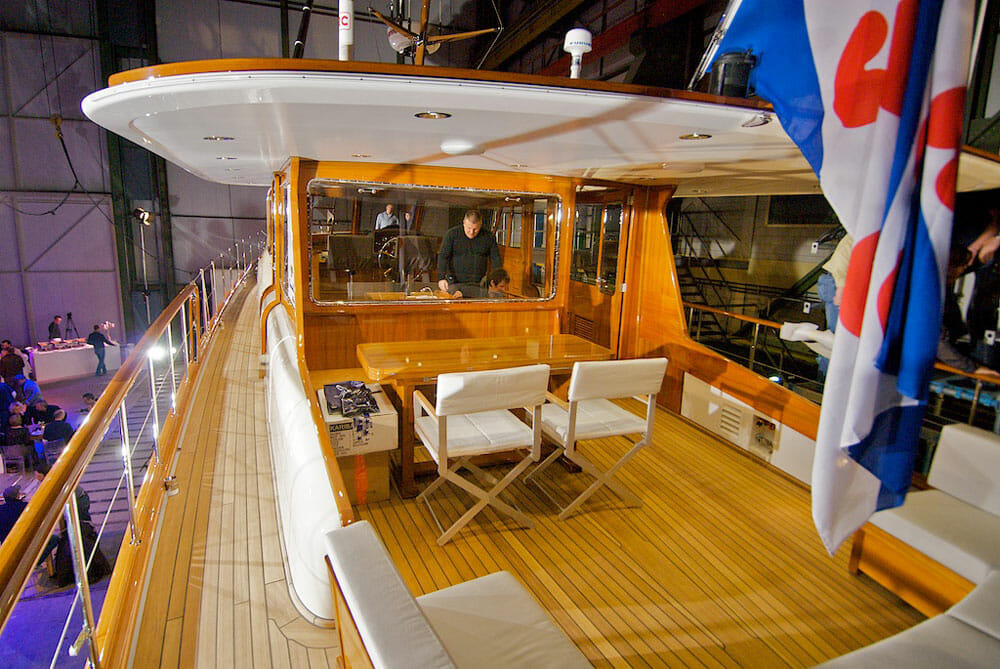
    The exterior was renovated according to the original design, keeping as much of the hardware intact to maintain the finish of the era in which she was built. Most of the superstructure housing was salvaged and went through a meticulous reconditioning process which included repairing the wooden structure and applying numerous new coats of lacquer. The wheelhouse roof and sundeck were reconstructed in aluminum to give a crisp and elegant new appearance.

    TAKEAWAY

    Feadship’s paid “Homage to Carlo Riva”, by honoring the original designer with nods to the original decor combined with modern design.

    BEFORE


    [Best_Wordpress_Gallery id=”11″]

    DURING


    [Best_Wordpress_Gallery id=”12″]

    AFTER


    [Best_Wordpress_Gallery id=”13″]

  • Interior Refit

    Interior Refit

    Interior Refit

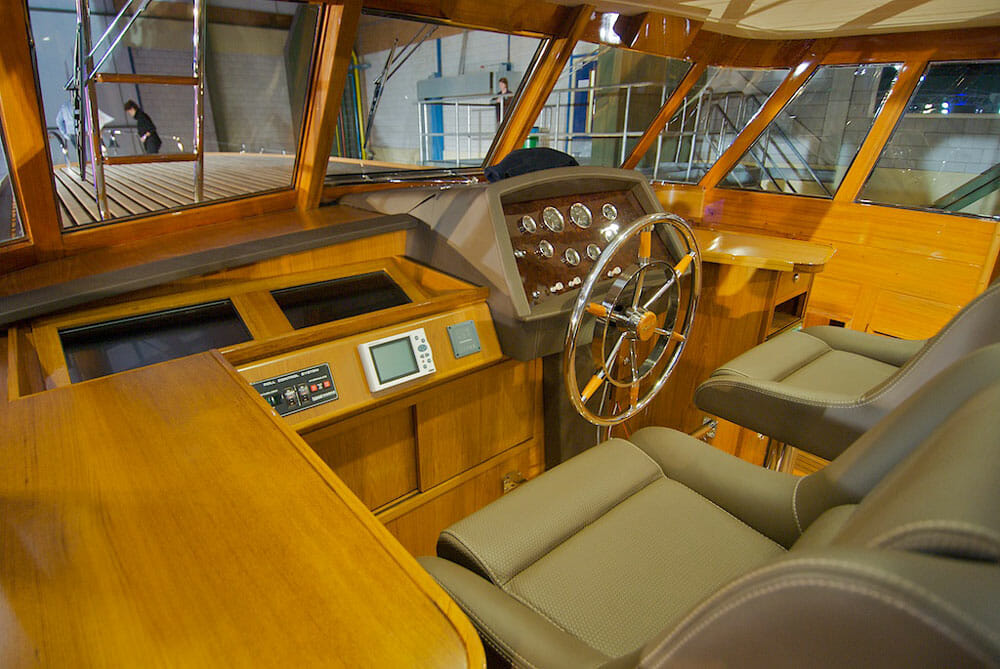
    Feadship’s in-house designers developed a contemporary style matching the original layouts and Sixties feel. Given the name “Homage to Carlo Riva”, it combines teak panelling with palisander furniture and leather detailing. 


    All soft furnishings feature natural ton-sur-ton colours blending in with the warm browns of the timber. The bright and airy main salon, with windows on three sides; spacious owner’s suite; lower deck cabins; and bathroom with Portoro marble floors and tops provides every comfort that one would expect onboard a Feadship mini-megayacht.

    {{ brizy_dc_image_alt uid='wp-a34792e0a0e7b6197d794b77d57dabef' }}

    TAKEAWAY

    Feadship’s paid “Homage to Carlo Riva”, by honoring the original designer with nods to the original decor combined with modern design.

    BEFORE


    [Best_Wordpress_Gallery id=”6″]

    DURING


    [Best_Wordpress_Gallery id=”10″]

    AFTER


    [Best_Wordpress_Gallery id=”8″]